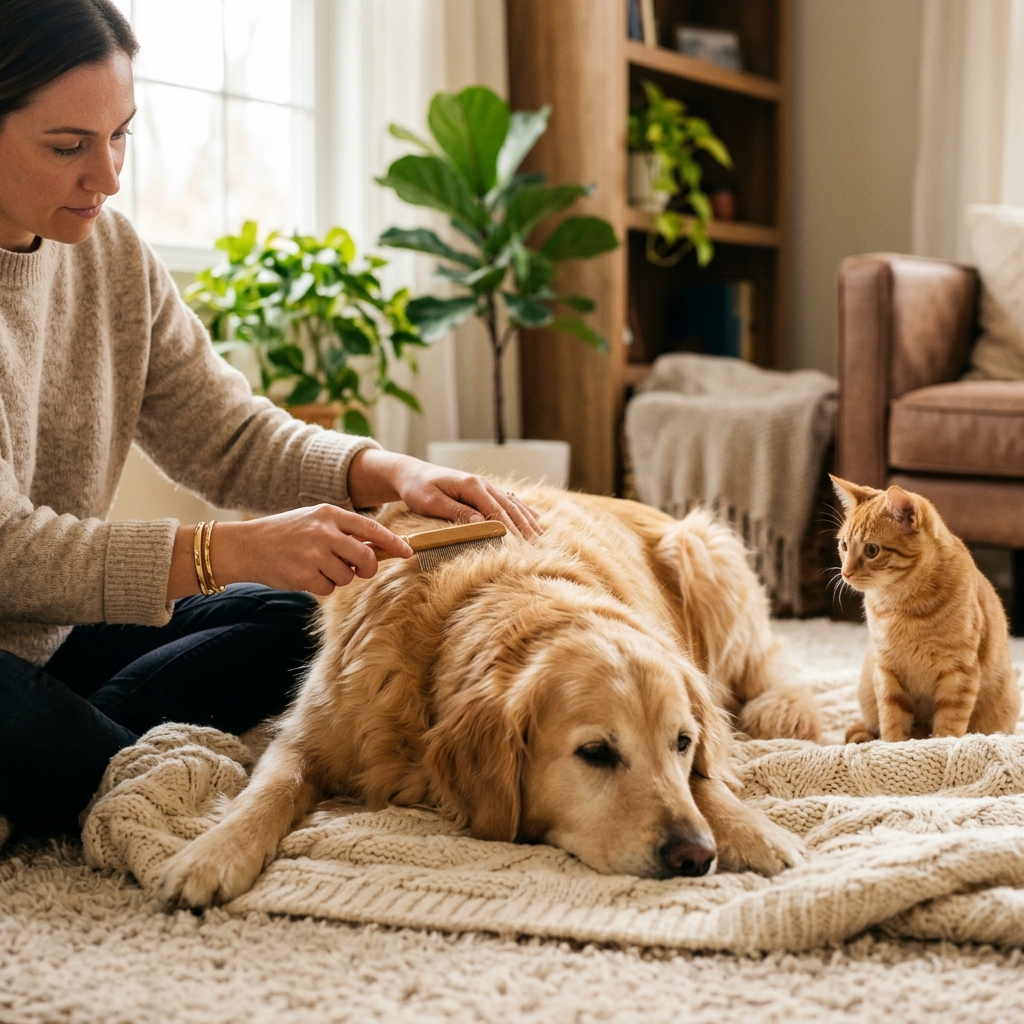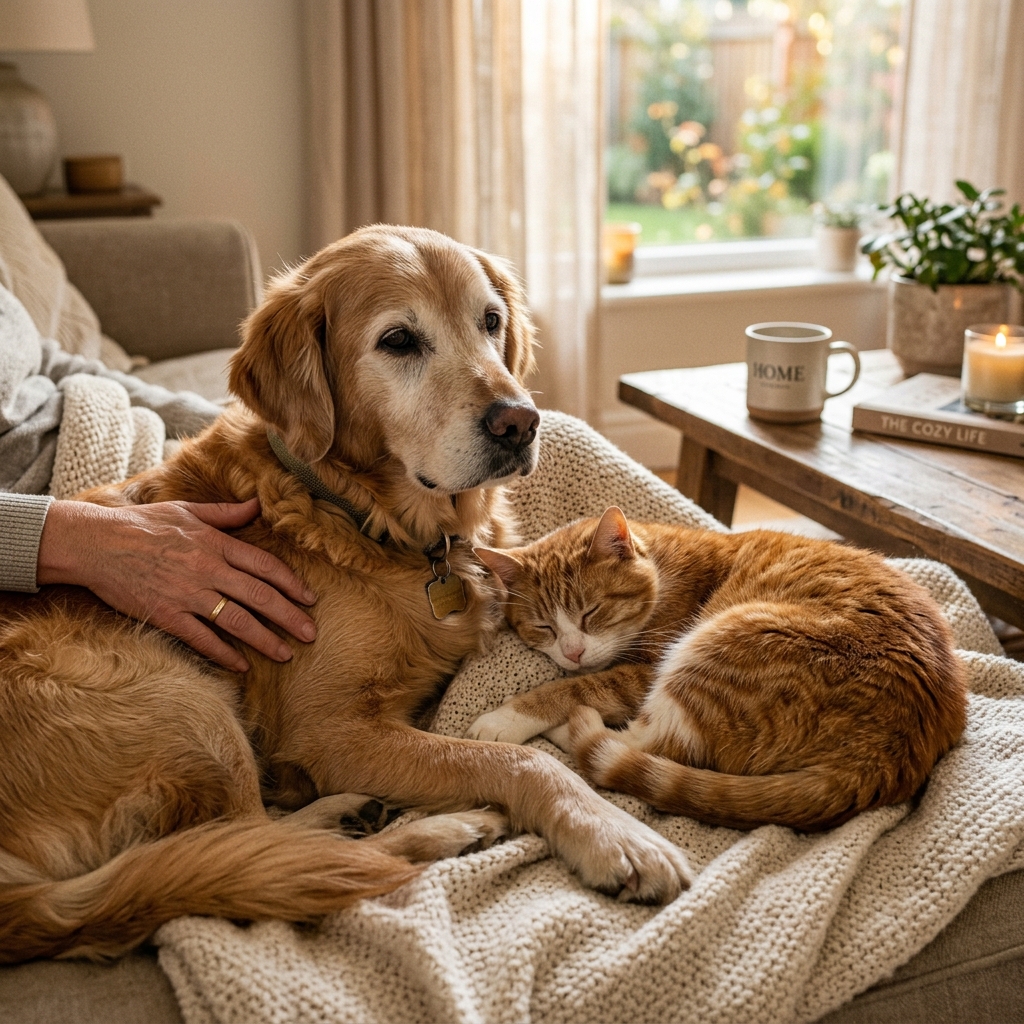
Have you ever watched your dog move more slowly to greet you at the door — or noticed your cat sleeping in sunbeams far longer than she used to? That quiet shift happens to every pet we love. One day we realize the puppy who used to race us up the stairs now takes them one careful step at a time, and the kitten who once ambushed our ankles now prefers a warm lap over adventure.
Caring for a senior pet is one of the most tender things we’ll ever do. It asks us to pay closer attention, adapt our home, rethink their meals, and sometimes hold space for difficult decisions. We’ve been through this with our own companions, and everything we share here comes from that lived experience — not a textbook, but a love story with a few harder chapters.
This guide covers everything we’ve learned about giving our fur babies the warmest, most comfortable golden years possible.
When Do Our Pets Become “Senior”?
Age isn’t just a number — it depends on size and species. Here’s a rough guide to when our companions cross into their senior chapter:
| Pet Type | Enters Senior Years |
|---|---|
| Small dog / cat (under 10 kg) | Around age 10–11 |
| Medium dog (10–25 kg) | Around age 8–9 |
| Large dog (25–45 kg) | Around age 7–8 |
| Giant breed dog (over 45 kg) | As early as age 6–7 |
| Cat (any size) | Around age 10–11 |
Early signs to watch for: a greying muzzle, slower movement, longer and more frequent naps, hesitation before jumping onto furniture, and a quieter, less playful demeanor. These aren’t causes for alarm — they’re invitations to adjust how we care for them.
Is Our Home Ready for Golden Years? 🏠
When joints stiffen and eyes dim, small household obstacles become real challenges. We made a room-by-room sweep for our own senior dog and were surprised how many friction points we found.
flowchart TD
    A[Senior Pet Arrives Home] --> B{Can They Navigate Easily?}
    B -- Yes --> C[Monitor monthly]
    B -- No --> D[Identify Problem Areas]
    D --> E[Slippery floors?<br>Add non-slip rugs]
    D --> F[High furniture access?<br>Add pet ramps or steps]
    D --> G[Deep food bowls?<br>Raise to elbow height]
    D --> H[Standard litter box?<br>Switch to low-entry box]
    E & F & G & H --> I[Re-assess comfort weekly]
Key upgrades that made the biggest difference for us:
- Non-slip rugs on hardwood and tile — senior pets slip and fall more easily, and a fall can mean a serious injury
- Pet ramps instead of stairs to reach beds and sofas
- Raised food and water bowls — reduces neck and back strain during meals
- Low-entry litter boxes for cats with arthritis (we cut a U-shape in the front of a standard box when we couldn’t find the right product)
- Orthopedic beds with memory foam or thick padding — sore joints need something softer than a mat on the floor
- Night lights in hallways for pets whose vision is fading
What Does a Senior Pet Actually Need to Eat? 🍽️
Nutrition shifts significantly in the golden years. The gut processes less efficiently, muscle mass drops, and specific organ systems — joints, kidneys, heart, brain — need extra nutritional support.
| Supplement | What It Helps | Notes |
|---|---|---|
| Glucosamine + Chondroitin | Joint cartilage repair | Best started before symptoms appear |
| Omega-3 (fish oil, EPA/DHA) | Joints and brain health | Also supports coat condition |
| Vitamin E + C (antioxidants) | Cell aging, immune function | Usually in senior formulas |
| B vitamins | Brain function, appetite | Especially useful for pets with CDS signs |
| Phosphorus-restricted food | Kidney support (cats) | Consult our vet for kidney-stage diet |
For senior cats especially, wet food or a moisture-rich diet helps maintain hydration — kidneys are a common vulnerability in aging cats, and dehydration sneaks up quietly.
For dogs showing joint stiffness, we’ve had good results adding a half-teaspoon of fish oil to meals alongside a joint supplement — the difference in our dog’s morning stiffness was noticeable within a few weeks.
Does Our Senior Pet Have Dementia? 5 Signs to Watch 🧠
Canine (and feline) cognitive dysfunction syndrome — what we tenderly call “pet dementia” — affects a surprising number of dogs over age 11 and cats over age 15. We used to think our dog was just being “weird at night.” Then we learned what we were actually seeing.
The five main signs of CDS:
- Nighttime howling, crying, or restless pacing — especially if they seem disoriented
- Staring blankly at walls or into corners for extended periods
- Forgetting familiar routines — where the food bowl is, which door leads outside, where the litter box is
- Withdrawing from family interaction — a previously affectionate pet who now seems indifferent
- Post-sleep confusion — waking up and seeming not to know where they are
If we notice three or more of these signs consistently, it’s worth discussing with our vet. While CDS isn’t curable, environmental enrichment (gentle puzzles, short sniff walks, a predictable daily routine) can meaningfully slow progression and keep our companion more comfortable.
How Can We Help With Arthritis and Joint Pain? 🐾
Arthritis is the most common condition we see in senior pets, and the good news is that gentle movement — not rest — is usually what helps most. Complete rest actually causes muscle atrophy, which puts more stress on the joints.
Low-impact exercises we love:
- Short, slow walks on grass or soft surfaces (avoid hard pavement)
- Gentle swimming or hydrotherapy (if your pet tolerates water)
- Passive range-of-motion exercises — gently flexing and extending each limb for 5–10 repetitions
- Massage — slow, warm strokes along the muscle groups beside the spine
Signs that today is a rest day:
- Limping after exercise (not before)
- Reluctance to put weight on a limb
- Whimpering when touched in specific spots
- A “tucked up” belly posture
We’ve learned to read our dog’s body language and skip the walk when he signals pain — a little rest is far better than pushing through and causing a flare-up.
What About Heart Disease and Kidney Issues?
These are the two most common serious conditions we face with aging pets, and both reward early attention.
Heart disease signs to watch:
- Faster breathing at rest (over 30 breaths per minute when sleeping)
- Coughing after lying down or at night
- Reduced exercise tolerance — tiring quickly on short walks
- Swollen belly (fluid accumulation)
Chronic kidney disease in cats often creeps in silently. Early signs include drinking more water than usual, urinating more frequently, and gradual weight loss despite eating. Cats are remarkably stoic, so weight loss is often the first clue something is off.
Both conditions are managed — not cured — but with the right diet and monitoring, many of our companions live comfortably for years after diagnosis.
Bedridden Care: When Our Pet Can No Longer Stand 💙
Some pets reach a stage where mobility is severely limited. This was one of the hardest periods for us, and we want to share what we learned about keeping a bedridden pet comfortable.
| Care Task | How Often | Why It Matters |
|---|---|---|
| Body repositioning | Every 2–4 hours | Prevents pressure sores |
| Skin and coat check | Daily | Catch sores early |
| Gentle limb massage | 2× daily | Prevents muscle contracture |
| Bladder support / diaper changes | As needed | Maintains hygiene and dignity |
| Oral care | Daily | Prevents infection |
The most important thing we learned: pressure sores develop fast — often within 24 hours of a pet losing mobility — and they’re painful and difficult to heal. Padding the sleeping surface generously (multiple layers of soft blankets) and gently turning them every few hours makes an enormous difference.
FAQ
When is a dog or cat considered a senior pet? Small dogs and cats generally enter their senior years around age 10–11, medium dogs around 8–9, and large breeds as early as 6–7. Watch for greying muzzles, slower movement, longer nap times, and reduced interest in play as early signs.
What home changes help an arthritic senior pet the most? Low-entry litter boxes and ramps over stairs make the biggest difference day to day. Add non-slip rugs on slippery floors, raise food and water bowls to elbow height, and swap a firm mat for a thick orthopedic bed to ease pressure on stiff joints.
What are the signs of dementia (CDS) in dogs and cats? The five main signs are: nighttime howling or restless pacing, staring blankly at walls, forgetting where the food bowl or litter box is, loss of interest in family interaction, and apparent confusion after waking from sleep.
Which supplements are most helpful for senior pets? For joints, glucosamine and chondroitin are well-regarded. Omega-3 (EPA/DHA from fish oil) helps both joints and brain health. Antioxidants (vitamins E and C) support aging cells. Cats with kidney concerns may benefit from phosphorus-restricted food and added moisture from wet food.
How do I know if my senior pet is in pain? Pets hide pain well. Key signs include reluctance to jump or climb stairs, licking or biting a specific spot, a hunched posture, loss of appetite, and changes in facial expression — a furrowed brow or squinting eyes can indicate discomfort.
What is the 5H2M palliative care assessment? 5H2M covers Hurt, Hunger, Hydration, Hygiene, Happiness, Mobility, and More good days than bad. Scoring these seven areas together helps families decide whether continued care is improving quality of life — or whether it may be time to consider letting go peacefully.
The 5H2M Checklist: Knowing When to Let Go
This is the hardest section to write, and the most important. The 5H2M framework — developed for palliative pet care — gives us a structured, compassionate way to assess our companion’s quality of life when things become serious.
| Letter | Dimension | Questions to Ask |
|---|---|---|
| H | Hurt | Is pain being managed? Are they comfortable more than uncomfortable? |
| H | Hunger | Are they eating enough to maintain body weight? |
| H | Hydration | Are they drinking and staying hydrated? |
| H | Hygiene | Can we keep them clean and free from sores? |
| H | Happiness | Do they still respond to family, toys, sunlight, or favorite things? |
| M | Mobility | Can they move enough to satisfy basic needs (bathroom, water)? |
| M | More good days than bad | When we look at the past two weeks — do good days outnumber hard ones? |
There’s no formula that tells us the right answer. But this framework has helped us have honest conversations with ourselves — and with our vet — about whether the care we’re providing is truly in our companion’s best interest, or whether the most loving act might be letting them go peacefully, in our arms, at home.
Whatever chapter we’re in with our senior pet, we hope this guide makes it a little warmer, a little more confident — and a lot more full of the love they’ve always given us.
Further Reading
- ASPCA — Senior Pet Care: Comprehensive overview of aging pet health from a trusted animal welfare organization
- The Spruce Pets — Caring for an Older Dog: Practical tips for daily life with a senior dog
- First-Time Dog Owner Complete Guide 2026: Our full guide covering the fundamentals of dog care from day one