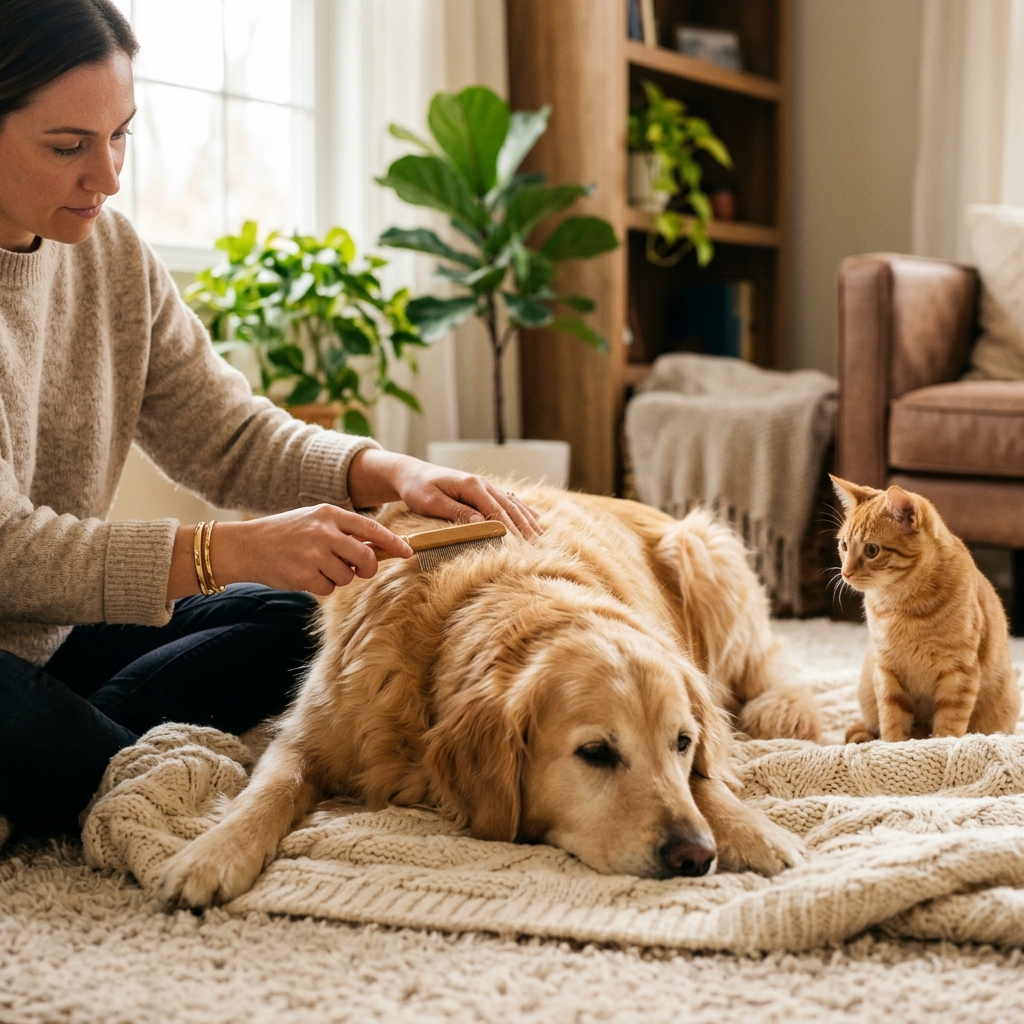
We still remember the morning we were brushing Mochi — our golden retriever — and noticed a small circular patch where the fur just… wasn’t there. It was roughly coin-sized, with a bit of flakiness around the edges, and she hadn’t seemed bothered by it at all, which honestly made it more unsettling.
We went straight to the vet that morning, and after a proper check-up we finally had a clear picture of what we were dealing with. What surprised us most wasn’t the visit itself — it was realising how much of Mochi’s recovery depended on what we did at home every single day. The right shampoo. The right home environment. Some simple additions to her meals. And a better handle on parasite prevention.
We’ve been keeping this four-part routine going for over a year now, and it’s made a visible difference — not just when things flare up, but in keeping her skin and coat consistently healthy. Whether your fur baby is dealing with something active right now or you’re just trying to get ahead of issues before they start, here’s exactly what works for us.
Should We Switch Shampoos When Our Fur Baby Flares Up?
We had no idea that the wrong shampoo could actually slow things down. Once we started matching the formula to what was going on with Mochi’s skin rather than just grabbing whatever was on the shelf, the change in her coat within a few weeks was genuinely surprising.
flowchart TD
    A[Skin issue noticed] --> B{Type of flare-up}
    B --> C[Circular bald patch with flaking]
    B --> D[Intense scratching and damp fur]
    B --> E[Red rash and ear irritation]
    C --> C1[Medicated shampoo<br>with chlorhexidine and miconazole<br>Control home humidity]
    D --> D1[Check for parasites first<br>Apply spot-on treatment<br>Oatmeal and aloe shampoo after]
    E --> E1[Low-allergen fragrance-free shampoo<br>Run air purifier<br>Add Omega-3 to meals]
Here’s the matching guide we’ve settled on after a lot of trial and error:
| Skin situation | Shampoo type we use | Key ingredient to look for |
|---|---|---|
| Fungal or bacterial flare-up | Medicated formula | Chlorhexidine + miconazole |
| After parasite treatment | Soothing recovery formula | Oatmeal + aloe vera |
| Allergy-prone or reactive skin | Low-allergen, fragrance-free | Collagen, coconut oil, no added fragrance |
| General maintenance | Mild moisturising formula | Gentle surfactants, no sulfates |
One thing we learned the hard way: keep using the medicated shampoo until the flare-up has completely cleared, not just until things look better. We stopped too early once and the whole cycle started again within two weeks.
A note if you have bunnies: Some medicated formulas — particularly those with miconazole — are not suitable for rabbits. Always double-check the label if your fur family includes a bunny.
Is Our Home Humidity Making Their Skin Worse?
This was the piece we had completely overlooked. Mochi’s skin was improving slowly, then suddenly came back — and the culprit was the humidity in our place rather than anything we were putting on her.
Fungal spores shed in fur and skin flakes can survive in damp environments for months. Our dog’s blanket, sleep mat, and our own towels were all silently harbouring the problem. The fix turned out to be pretty simple once we understood it:
| Home habit | Why it matters | How often we do it |
|---|---|---|
| Sun-dry Mochi’s blankets and sleep mat | UV light kills lingering fungal spores | At least once a week |
| Run the dehumidifier | High humidity = ideal environment for fungi and dust mites | Daily during humid months |
| Run the air purifier | Reduces airborne allergens and pollen | Ongoing |
| Vacuum fur baby’s sleep area | Removes shed fur, dander, and debris | Every 2–3 days |
For dust mites specifically — which are often behind allergy-related skin reactions — keeping indoor humidity below 50% makes a noticeable difference. Our dehumidifier is almost always running from April through September in Taiwan.
Can What They Eat Help Their Skin Recover?
We were sceptical about this one at first. “It’s just fish oil — how much can it actually do?” Turns out, quite a lot.
Omega-3 fatty acids (found in fish oil) and Omega-6 (found in evening primrose or certain plant oils) both play a real role in maintaining and repairing skin from the inside out. Mochi gets a small squeeze of fish oil poured over her kibble every morning, and within about three weeks of starting, her coat went from dull and slightly tacky to proper glossy-and-smooth.
If your fur baby has a food sensitivity that’s showing up on their skin, the diet piece becomes even more important. We switched Mochi to a limited-ingredient kibble for a while to help isolate what was causing the reaction, and keeping her off the trigger food consistently was honestly the most effective thing we did.
A few things that work for us:
- Fish oil (Omega-3): Added to meals daily — we use a pet-specific formula to get the dosage right for her weight
- Limited ingredient food: Fewer mystery ingredients means fewer potential triggers to sort through
- Plenty of fresh water: Hydration isn’t glamorous, but it’s real skin support — we refill Mochi’s bowl several times a day
Are We Actually Using Parasite Prevention Correctly?
This section might sound basic, but we were honestly doing this wrong for the first year we had Mochi — and it was affecting how well the products worked.
The biggest mistake we made was applying the spot-on treatment onto her fur rather than directly onto the skin. The product needs skin contact to absorb and spread through the natural oils across the body. When it lands on a thick layer of fur instead, it can’t do its job properly.
The right way:
- Part the fur all the way down to the skin — usually at the back of the neck where she can’t lick
- Apply the product directly to the skin surface
- Wait at least 72 hours before bathing (some products recommend waiting up to two weeks — check the label)
We do monthly spot-on prevention year-round. After a treatment, we use our oatmeal-and-aloe shampoo for the next two or three baths to help the skin recover and stay comfortable.
Reading the coat like a health report
Mochi’s coat is genuinely one of the first things that tips us off when something’s not right. Here’s what we watch for:
| What we observe | What it sometimes means |
|---|---|
| Silky, shiny, smooth to the touch | Things are good — keep doing what we’re doing |
| Dull, dry, or slightly rough | Time to check fish oil, hydration, and brushing frequency |
| Sparse or thinning patches | Worth a closer look — could be shedding season, could be more |
| Fur clumped or matted near the skin | Often linked to moisture getting trapped — review bathing routine |
| Black specks in the fur | Classic flea sign — time to check and treat |
FAQ
How can we tell if a fur baby’s skin is healthy just by looking at their coat? Healthy skin shows up in the coat — silky, shiny, and smooth to the touch. When we notice dullness, sparse patches, or fur that feels rough and clumped, that’s usually our first sign something’s off and we start paying closer attention.
What shampoo should we switch to when our fur baby has a skin flare-up? It really depends on what’s going on. For fungal or bacterial flare-ups we use medicated shampoos with chlorhexidine and miconazole. For skin recovering from parasites, oatmeal-and-aloe is gentle and soothing. For allergy-prone skin, we reach for fragrance-free, low-allergen options.
Does home humidity really affect our pet’s skin that much? More than we expected! Fungal spores can linger in damp fur and bedding for months. Since we started running the dehumidifier consistently and sun-drying our dog’s blankets, flare-ups have been noticeably less frequent.
Can adding fish oil to their food actually help their skin? It’s one of the easiest wins we’ve found. A daily squeeze of fish oil added to meals made our dog’s coat noticeably softer and shinier within just a few weeks. It won’t fix a serious flare-up on its own, but as a daily habit it genuinely helps keep the skin barrier strong.
What’s the most important thing to remember when applying spot-on parasite treatments? Part the fur all the way down to the skin before applying. If the product lands on fur instead of skin it can’t absorb or spread properly. Also, avoid baths for at least 72 hours before and after — some products ask for even longer.
How often should we bathe a fur baby with sensitive or reactive skin? We try to keep it to every 10 to 14 days — over-bathing strips the natural oils that protect the skin. On in-between days, a gentle damp-cloth wipe-down keeps things fresh without disrupting the skin’s natural balance.